Integrated circuit design · UHF RFID
One idea changes a habit.
We design passive, battery-free, ultra-low-power UHF RFID ICs that give every product an identity, from origin to point of sale.
2 patent filings in progress
What we do
From transistor to silicon.
XABIC is an analog and digital integrated circuit design company specialised in passive UHF RFID. Every block is designed and verified at transistor level with one clear goal: ICs that always read, even in the toughest conditions.
Power from the air
No battery. The IC turns the reader’s radio wave into the energy it needs.
Unique identity
Each tag stores a unique code for the product it travels with, contactless and with no line of sight.
Full traceability
Hundreds of tags read in seconds from several metres away, across the whole supply chain.
The problem
What you can’t see, gets lost.
Empty shelves while stock sits in the warehouse, shipments nobody can locate, food that expires unsold, counterfeits passing as originals. It all starts the same way: not knowing where each item is.
An RFID IC in every product changes that. Each item identifies itself, from a distance and untouched, and that data drives the entire chain.
The data
What every tag tells your business.
You can't see the IC, but you can see what it says. Every read turns a product into data: where it is, how many are left, when it expires and whether it is genuine.
LIVE
Illustration.
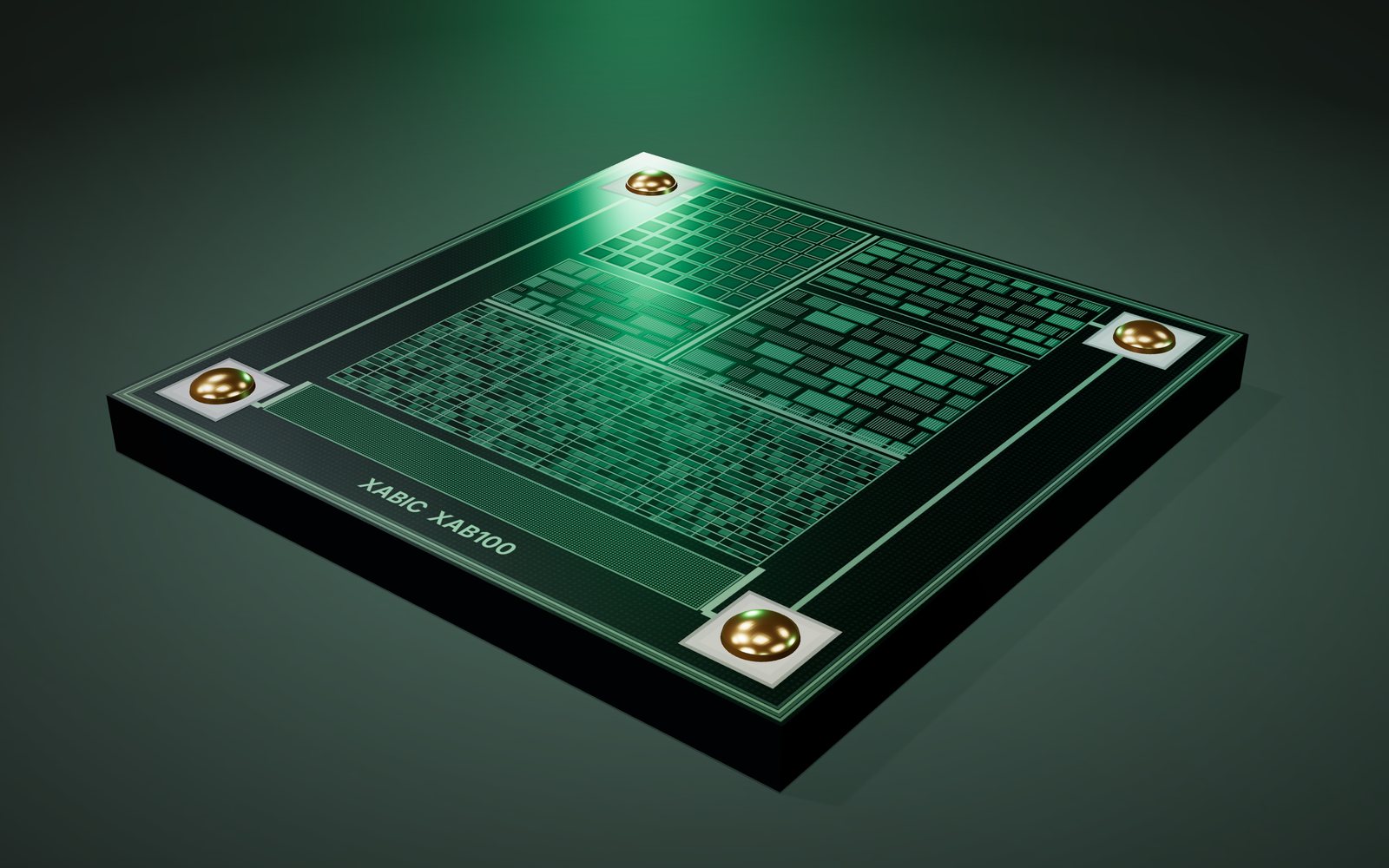
XAB100, our first IC.
A passive UHF RFID IC built to read further and respond the same in cold, in heat and surrounded by other tags.

How it works: the reader sends a radio wave. The antenna picks it up and powers the IC, which answers with its identifier. No batteries, no wires, from more than 10 metres away.

Small on the outside, demanding on the inside.
The XAB100 fits on the tip of a pin and has no battery: all its energy arrives by radio from the reader. That is why every block is designed to run on microwatts, wake up with very little signal and respond the same across every process and temperature corner.
- Reads further. Higher sensitivity means more metres of range and fewer missed tags.
- Always responds. Designed and simulated in cold, in heat and across all manufacturing variations.
- Standard-ready. Compatible with the UHF RFID readers the industry already uses.
| Type | Passive UHF RFID, battery-free |
| Frequency band | 860 – 960 MHz |
| Read sensitivity | −25.5 dBm |
| Operating temperature | −10 °C to +85 °C |
| Technology | CMOS 130 nm |
| Intellectual property | 2 patent filings in progress |
Design target specifications, subject to change.
Antenna and matching
Antenna design, made simple at last.
One of the biggest headaches in UHF RFID is matching the antenna to the IC’s impedance. With typical ICs, highly capacitive and high-Q, every tag needs fine-tuned matching that drifts with material, size or manufacturing.
- Impedance designed for the antenna. The XAB100 is designed from day one so its impedance is easy to match.
- More tolerant matching. Less sensitive to variations in material, assembly and process.
- Fewer iterations. Tag makers reach a working design sooner.
Qualitative illustration.
For tag makers
Do you make inlays or tags? Let's talk.
We are looking for manufacturers who want to design their tags with the XAB100 from the start.
- Early access to the first samples.
- Support to design and match the antenna.
- Impedance data for your simulation in CST or HFSS.
How it works
From radio wave to response.
In microseconds, the XAB100 wakes up, powers itself, understands the reader and answers back. All with the energy that arrives through the air.
The antenna picks up the reader’s UHF signal.
It turns it into the energy that powers the IC.
The IC wakes up with a clean, stable start.
It interprets the reader’s commands and reads its memory.
It reflects the wave back carrying the product code.
Calculator
How far does it read?
Move the reader power and choose the environment. With −25.5 dBm sensitivity, the XAB100 answers from far away.
In Europe, the maximum regulated reader power is 2 W ERP (33 dBm).
Estimated read range
Tag antenna
Product
Cardboard · εr ≈ 2 · σ ≈ 0,005 S/m
Aluminium · σ 2·10⁶ S/m
Estimación teórica a 866 MHz con antena de etiqueta de 2 dBi. Incluye 3 dB de pérdida por polarización la pérdida típica de una etiqueta estándar sobre cada material y la pérdida de eficiencia de la antena según su conductividad. Valores de εr y σ típicos a 900 MHz. El alcance real depende de la etiqueta y del entorno.
Antenna and material
The antenna matters too.
Range also depends on the antenna conductor. With aluminium or copper the XAB100 uses all its sensitivity. And with printed inks, the XAB100 gets more out of them: its easier-to-match impedance lowers the current in the matching loop, and with it the conductor losses.
Theoretical estimate with XAB100 (−25.5 dBm), reader at 2 W ERP, 866 MHz and a 2 dBi tag antenna. Assumed efficiency loss: silver 1 dB, graphite 9 dB.
Why XABIC
Designed never to fail.
We put robustness first: an IC that always reads is worth more than one that reads very far only in the lab.
High sensitivity
Wakes up with very little signal from the reader.
Robust across temperature
Simulated across all process corners, from −10 °C to +85 °C.
Ultra-low power
Runs on microwatts, the energy that arrives by radio.
In-house design
Every analog, digital and RF block, designed and simulated by our team.
Applications
Every product, located.
UHF radio identification is already the standard in industries that need to know where every item is.
Retail and fashion
Real-time inventory, automatic restocking and queue-free checkout.
Logistics
Pallets, cases and shipments identified at every point in the chain.
Healthcare and pharma
Batch, expiry and authenticity control for every medicine.
Industry
Tracking of parts, tools and assets on the factory floor.
Food
From farm to shelf: origin, cold chain and freshness under control.
Authenticity
Brand protection and the fight against counterfeiting.
Our story
From New York to Madrid.
The idea is born in New York in 2024, with two engineers: a market, an idea and a solution. Today, in Madrid, the XAB100 is fully designed, with sensitivity and reliability on a par with the industry’s biggest players.
Roadmap
From paper to silicon.
The idea is born
Two engineers in New York: a market, an idea and a solution.
XAB100 designed
Full design, simulated in 130 nm. 2 patent filings in progress.
First samples
First silicon and tests with real readers and tags.
Production
XAB100 tags built with inlay manufacturers.
Every product has a story to tell.
We give it a voice.
Contact
Shall we talk traceability?
If you want to learn about the XAB100, work with us or receive samples when they are available, write to us.